Educate | Propagate | Inspire

Ecosystem Solution Institute

Edible Tree Program
One Tree and Companions Plants for an Abundant & Resilient Future


Community Edible Tree Sponsorship
Apply to receive a tree and companion plants for your yard. Grow your yard over the years through our sponsorship of plants and educational events to become an edible ecosystem. Your site is part of our database of research for tree suitability to different hardiness zones, soils, and community needs.

Become an EPI Site
Transition your tree planting into an Education Propagation Inspiration (EPI) site with the addition of plant name tags, educational signage and your own community stewardship mission statement. Become a steward who educates, propagates and inspires more edible sites in your community.


Edible Biodiversity Conservation Area
As part of our program you are participating in the outreach of the Edible Biodiversity Conservation Area (EBCA) that includes a 100-acre project in Ontario with thousands of trees planted for research and propagation. Your site is now a seed of this larger edible ecosystem landscape. We are all working to test community-based land transition to ecosystem services for abundance and resilience!

Apply Today!
Your edible ecosystem yard is a click away. We are paying for the full cost of an apple, plum or mulberry with currant and rhubarb companions and a native understory of giant hyssop, violet and wild strawberry!
1. DOWNLOAD application,
2. FILL the application,
3. RETURN by email.
How to Plant Your Edible Yard? It is as easy as 1... 2... 13!
Describe the key features of the service and how users can benefit from it.

01.
Apply for the 2026 Edible Tree program by downloading the fillable PDF and emailing it to: epi.ecosystemsolution.com
If your paper work is in order you will be accepted, so long as our supplies last! Your MUST: plant in your front yard and be in our target neighborhood or be approved for a different area.
02.
Mark the day of planting: June 6, 2026 on your calendar because you must be available to plant this day!
03.
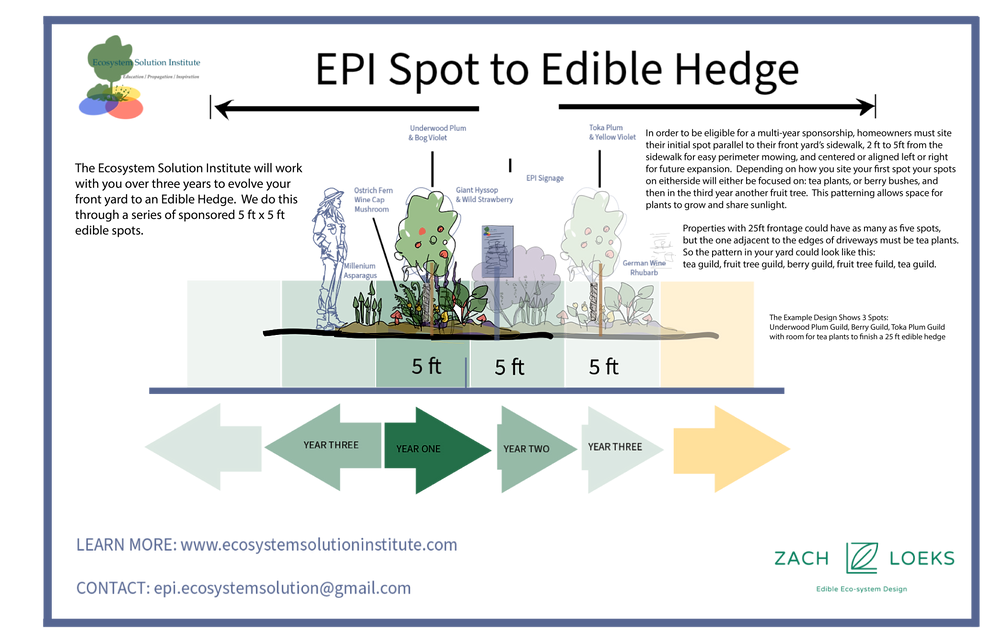
Find the best location for your 5 ft x 5 ft spot in your yard following our suggestions below in the "How to site your spot?" section.

04.
Prepare your soil by loosening the soil 12" and layer your cardboard sheet mulching across entire planting area, make sure to twice layer so there are no gaps.
You MUST: "Call Before You Dig"! Call 1-800-940-3447 (3-5 business days before digging into your yard!)
05.
Pick up your tree with companion plants, soil, mulch and other supplies at the assigned pick-up in your area on June 6, 2026! (location will be sent by email)
06.
Build your cedar planter box by squaring it over your cardboard parallel to your side walk and squared with driveways (see our video and details below).
07.
Mix in compost into your planter box till it is 2" below the lip.
08.
Plant your tree with trellis stake and rodent guard by following the design provided and planting protocol.
Plant your companion plants into their specific locations following our design and protocol.
09.
Cover over your entire planting area with Typha mulch, snug the mulch in around your plants, but don't cover their leaves. It can be easier to plant trees, asparagus and rhubarb before mulching; and the other plants after mulching.
10.
Water your planting thoroughly, and water every day unless it rains for one week, then water twice a week for a month, and then once a week for the rest of the summer, unless it rains.
11.
Make sure the plastic tags are tucked low on the plant and do not come off.
12.
We will come by to inspect the site, install your EPI spot name plate and put you into our database for research. your EPI sign lists all the plant names in English and latin.
13.
Learn to maintain and enjoy your edible ecosystem spot! You have succeeded and are now eligible for another spot next year!
How to site your Spot


Edible Spot Design

-
Your planter is 5 ft x 5 ft. The cedar sides are 6" wide, leaving a 4 ft x 4 ft inside dimension. Mark this off into nine squares.
-
See above left for the planting pattern of trees and companion plants.
-
First plant your fruit tree in the middle.
-
Now, follow the pattern.
-
If your street is south of the planter, plant the front square like this: Western Canada Violet, Wild Strawberry, Giant Hyssop. Plant the side square in Millennium Asparagus, making sure to plant the crowns deep. Leave the other square for Wine Cap mushroom inoculant, which we will do.
-
The back row will have Bog Violet, Ostrich Fern, with edible fiddleheads, and German Wine Rhubarb.
-
If your street is north of the planter, then the back row becomes the front row. Everything else is the same.
-
Note: see advice below with more details. Your tree, asparagus and rhubarb must be planted deep and properly!
How to plant?

-
Each plant has different planting needs and a different sequence of planting.
-
First, you must plant your tree before putting down your mulch.
-
The tree is bare-root, meaning it doesn't come in a pot. Instead, it has a taproot and side roots, often shaped like a hand with many tapering roots radiating out.
-
It is important to dig a hole wider than the longest lateral root and deeper than the longest taproot.
-
Then place your tree into the hole. It can be beneficial to have someone hold the tree by its stem while a second person fills the hole by hand.
-
As you fill the hole, try to layer the lateral roots so they don't all get pressed into the bottom of the hole and forced to hug the taproot.
-
Instead, allow the roots to be layered by lifting them as you crumble loose soil into the hole.
-
Once the hole is filled, hold the stem of the tree and step gently on either side to firm it up and make sure it is anchored.
-
Maybe add some additional soil to make sure there is enough soil to cover the highest roots on the stem.
-
You will notice the tree has a flare just above the last root, the base of its future trunk. This is where the graft is.
-
Fruit trees are often grafted onto a related rootstock that helps them with hardiness and keeps them smaller for easy picking.
-
DON'T break the graft by pushing or pulling too hard on the tree. DON'T bury the graft in the soil. Turn the graft, ideally, away from the south.
-
Once your tree is planted, you can install the rodent guard by wrapping it around the tree stem and pressing it into the soil so it doesn't lift up in the snow, protecting against rodents from girdling and killing the tree.
-
Now you must plant two additional plants before you spread your mulch.
-
Asparagus comes as a crown, the thick succulent roots of the plant. You must plant them 8" deep and keep the small young spear tips pointing up. You can spread the mulch over the surface.
-
It is recommended to cover them with 3" of soil and then continue to cover them with more soil as they grow until you reach the level surface.
-
The rhubarb can also be planted. You will have a chunk of rhubarb root. Plant it 6" deep with the red shoots up, and cover all but the tips.
-
Now you can mulch the entire bed top evenly.
-
The rest of the plants should be planted as per the design by lifting them from their pots gently, pinching the bottom of the soil and root mass to make sure the roots at the bottom are broken and free to grow into the soil.
-
Part the mulch gently in the middle of the chosen area, dig a hole the same size as the soil mass/pot size, and place the plant into the hole. Fill in around it and press down with your hands.
-
Fill in again with extra mulch.
-
Now you can pound your wooden stakes in for tree supports by placing the stake 4" from the tree trunk, ideally on the windiest side, so the tree can pull against the stake when the wind blows.
-
For plums, you will get two stakes, as they tend to lean more.
-
Tie your tree to the trellis stake with your reused drip tape tie.
-
You have planted your tree and companions, mulched your spot, and installed the rodent guards and trellis stakes.
Larger Sites?
Parks, Schools, Community Centres, Spaces of Worship, Museums...
Download the PDF

Expand your edible plantings?
Download the PDF